Wednesday, February 15, 2017

Whitley Moody: Blog Post #7

          My Story of the Seed group and I have been examining the reproductive process in the flowers created on one of the species of Brassica Oleracea plants.  We have researched how the parts of the plant are being fertilized in order to reproduce.  We learned of a few important reproductive organs in our flowers.  The stamen is the male reproductive organ and the pistil is the female reproductive organ.  It all starts at the stamen of the flower.  At the end of the stamen is an anther.  On the anther pollen is created through Meiosis.  In order for reproduction to happen, the pollen made on the anther must find its way to the stigma.  The stigma is the sticky end to the pistil which is the female reproductive organ of the flower.  After the pollen has reached the stigma it is taken through the stalk of the pistil to the ovary at the base of the pistil.  In the ovary the pollen germinates the ovules where the reproduction process begins.
Here is a picture of the whole flower we took from a species of Brassica Oleracea.  You can see all petals, the anthers, the stamen, the stigma, and the top of the pistil.  The ovary is hidden because it is at the bottom of the pistil(female reproductive organ). 
This is a close up photo of the male reproductive anatomy of the flower.   This part of the flower is called the stamen.  The end of the stalk is called an anther.  The anther is where the pollen is created through Meiosis.  The pollen created on the end of the anther is the pollen that will eventually reach the female organ of the plant so that the plant can reproduce.  The long stalk on the male reproductive organ is called the filament.
This is a close up of the female reproductive anatomy of the flower.   This is called the pistil.  As seen in the photo, the end of the pistil is larger than the rest of the stalk.  That part is the stigma. The stigma is sticky.  This allows the pollen from the stamen (male reproductive anatomy of the flower) to stick where it can germinate the female reproductive organ which starts the reproductive cycle.  There are many ways for the pollen to reach the stigma.  For example, wind can blow the pollen from the stamen to the stigma. 
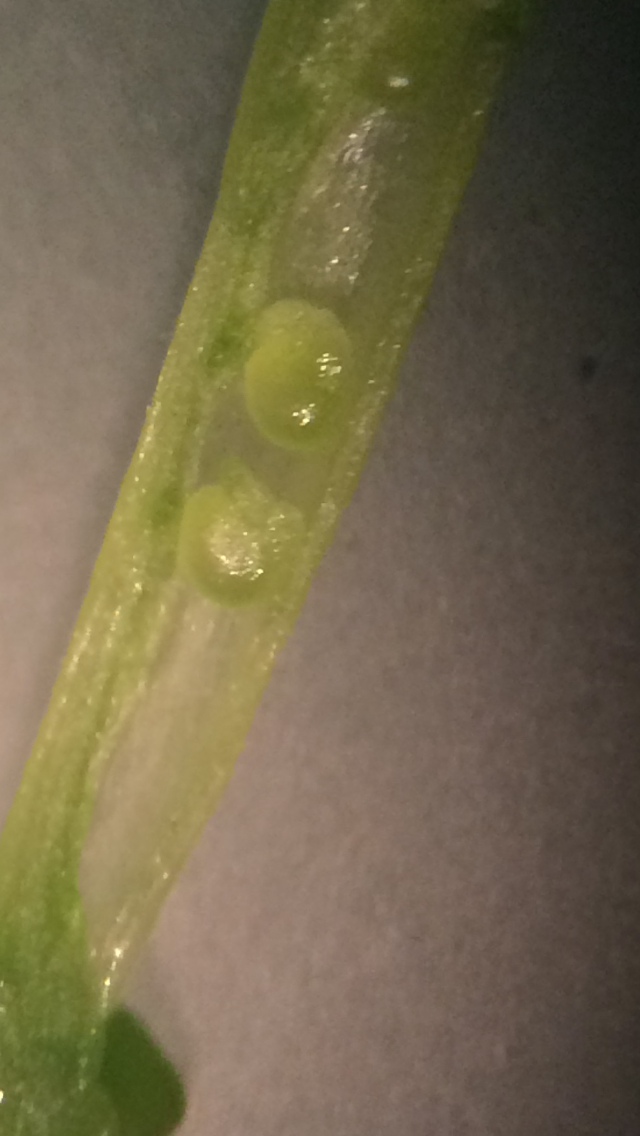
Here is a close up of the flower that has been completely stripped of all parts except the ovary.  I have opened up the ovary to get a clear view of the ovules.  The ovules are the tiny unfertilized green pea-like shapes.  This is where the pollen from the stamen will eventually go to start the reproductive process.


EXTRA:

This is a magnified view of the pollen taken from one of the anthers.  Done using a wet mount slide of pollen and a compound light microscope.

Blog Post #7 -Annika Gordon

These are the flowers I picked to view under the microscope to look at the parts of a flower up close. Out of these flowers my partner, Christina, and I chose just one, but ended up needing several as we messed several times. We made sure to pick flowers with larger anthers and pistils so that we would be able to see all the different parts more clearly than on small anthers and stigmas.
This image is of the anthers, which is part of the stamen, the male anatomy of a flower. It surrounds the pistils showing that this particular flower is both male and female, whereas some are just male or just female. The anthers grow at the end of stamen and consist of a sac which produces and releases pollen. This pollen is then picked up by birds, bees, and other insects on their bellies and feet when they land and transferred to the stigma of neighboring flowers.
This picture is of the the female anatomy of the flower, the carpel also know as the pistil, which contains the stigma, style, and ovary. The stigma is the sticky top which pollen grains attach to, and could be considered the landing zone for these pollen grains. The style is a long stalk which connects the stigma and ovary allowing the pollen that lands on the stigma to transfer sperm cells down into the ovary. In the ovary ovules are produced which when fertilized by sperm cells eventually become seed allowing for the flower species to continue living.
These are images of the inside of the pistil, more specifically the inside of the ovary which was cut in half so we could understand what was inside. The little round balls, more obvious in picture two, are unfertilized ovules. When they aren't underneath a microscope, they are smaller than even a grain of rice, but are the reason plants can reproduce. Without ovules the sperm cells from the pollen wouldn't have anything to fertilize, marking the end of that plant species life.
This image shows a very close up view of the pollen found on the anthers of our flowers which is used as a "capsule" for sperm cells. Pollen is grown on the anthers of plants and when picked up by wind or insects are transferred to the stigma of another plant. This picture is taken from a light microscope where we zoomed in so much you could see little ridges all over in, but the picture didn't capture them, so in reality pollen is actually smaller than even a grain of sand, yet it might just hold more importance.

Tuesday, February 14, 2017

Katie Inman Blog Post #7

This is the flower that my partner and I collected from the garden. It is from the brassica family and is a mature flower. Plants reproduce in a similar way that humans do, with male and female reproductive organs. Although not all plants are just male or female, some are both. In this brassica flower, it is both male and female which means it includes both genders gametes.


 These four pictures are showing anthers(yellow) which are connected to the stamen(green). Inside of the anthers are mircosporangium. Microsporangium is a sporangium which gives out spores that then become the male gametophytes. When the plant begins to flower, the microsporangia make microsporocyte, which then splits into 4 more cells through meiosis. Then through mitosis the microspores become pollen grains.  The pollen grains are the male gametophytes and when matured enough they become less attached to the anthers and are ready to continue in fertilizing the the female gametophytes.


 This picture is showing the pistil and at the top is  stigma which is the entrance for the pollen grain to the ovary. When the pollen grain or sperm germinate on the stigma it absorbs water and nutrients, opening a small pollen tube that goes through the style and into the ovary. Once the sperm reaches the ovaries it fertilizes the ovule creating diploid cell with a set of chromosomes from the mother(egg) and father(pollen)
Here we see the eggs or ovules inside the ovary. This is before they are fertilized. When they become fertilized the ovule becomes a zygote. A seed then develops from each ovule. In each seed their is a new sporophyte or embryo covered by a layer of tissues and a supply of food.  Then when the ovary walls become denser and the fruit that comes from the particular plant begins to form around the seed. When given the proper conditions the seed will begin to grow or germinate. It will begin to use photosynthesis once ready and until then it uses the food supply. After this it has completed the circle of life and the process will repeat over and over again


EXTRA: Using a compound microscope my partner and I took a picture of the male gametophytes/sperm/pollen. 

Wednesday, January 18, 2017

How Does Your Garden Grow? Blog Post #6 Annika Gordon

Our plant uses photosynthesis, cell division, and cellular respiration to grow bigger and add biomass, though it seems to be doing this very slowly. When the chlorophyll in the leaves soaks up sunlight during photosynthesis it helps our plant grow bigger, this happens its entire life. It uses cell division to grow back parts of leafs that may have been eaten, and to grow taller so it can get more sunlight and not be left in the shade by the plants surrounding it. Our plant, though small, still uses cellular respiration to produce sugar, ATP, and carbon dioxide, all things which help its growth progress. If a signal was to be sent to the nucleus of the cells in our plant, PEPC and Rubisco would be produced more. This would happen because they are enzymes and enzymes are proteins which make a reaction speed up. The enzymes in plants are partially responsible for its growth, so by producing more PEPC and Rubisco our plant would grow faster.

Katie Inman blog post #6

1. It was  a little hard trying to find our plant today, due to the rapid growth of the grass in the garden.. Our plant is still one of the smallest and is still being eaten by some time of insect. It helps create more biomass by feeding next level consumers, helping their level grow and produce more. Through the process of photosynthesis, not only our plant but all living things in the garden, continue to transfer sun light into energy so they can grow and increase the biomass on their level. It uses mitosis to duplicate the cells making more and making the plant bigger. Also, it uses cellular respiration to release carbon dioxide back into the atmosphere.


2. A signal could be sent to the nucleus  to make the enzymes Phosphoenolpyruvate carboxylase (PEPC) and ribulose 1,5-bisphosphate carboxylase/oxygenase . Then it could make more since they are proteins. part of photosynthesis, involves these enzymes. The plant uses the enzyme to speed up i digesting other parts of the plant.

Friday, January 13, 2017

Blog Post Assignment #6 : Maddie Gong

1. Our plant hasn't grown much since the last time we saw it. But, many other group's plants are growing a lot around ours. The chloroplasts in the plants are taking in sunlight and using energy to convert water and carbon dioxide into glucose and oxygen. The plants are also creating energy, sugars and other gases through the process of photosynthesis. Cell division also takes place and new duplicate cells are formed in the plants. Similar to photosynthesis, plants undergo cellular respiration and use oxygen and glucose to create carbon dioxide, water and more energy. All of these products help to power the functions of the cell and start all the processes over again.

2. If a signal was sent out to the nucleus of one of our plants to produce more enzymes such as Phosphoenolpyruvate carboxylase and ribulose 1,5-bisphosphate carboxylase/oxygenase the plant cell would start to make more proteins to end up producing more enzymes. The enzymes in the plant are part of photosynthesis and used to digest parts of the plant. They move all around the cell and help speed up some of the processes. The double helix of the particular part of DNA that coded for the required protein would be unzipped, make a complementary strand to one of the DNA strands and re-zipped by RNA Polymerase. Then, the two processes of transcription and translation occur. First, a ribosome would attach itself when the mRNA travels outside the nucleus. Next, the codons or triplets of RNA nucleotides are read by the ribosome and the twinning amino acid for each of the codons are brought by tRNA. After the last process, translation, all the specified amino acids from the mRNA codons have created a protein, or the enzyme the nucleus commanded.

Whitley Moody Blog Post #6

Our plant is still just about as small as it was the last time we checked it a few weeks ago.  But, I did realize that other plants are growing bigger.  Through photosynthesis the plants are growing new organic matter that is contributing the their total biomass. Cell division also contributes to the growing of the plants. Cells divide in order to help organisms grow and reproduce, so the more the cells divide the faster the plants will grow.
The plants would make the enzymes phosphoenolpyruvate carboxylase and ribulose 1,5-biphosphate carboxylase/oxygenase very quickly if a signal was sent to the nucleus because they help with photosynthesis and photosynthesis helps the plants grow.   This would happen because enzymes belong to the protein biomolecule group and proteins are shot quickly around the cell, meaning the growing and producing of those enzymes would go very quickly.